
Why Flies Target Your Face: Odors, Heat, and Instinct

Introduction
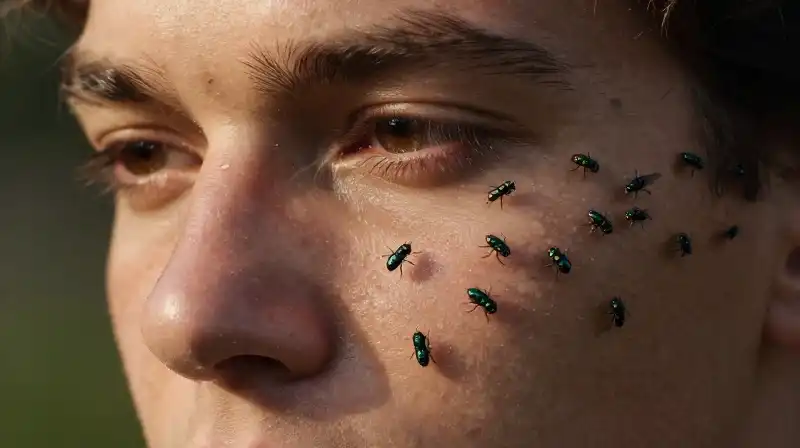
The common experience of a fly landing or actively circling your face is rarely an act of malice or a “purposeful” invasion in the way humans understand intent. From a biological perspective, when flies target your face, it is almost entirely driven by deeply ingrained instinct and a rapid, relentless response to potent sensory signals. For a fly, your face is not a location; it is a rich convergence of vital resources. This strong attraction stems from a combination of chemical attractants, thermal signals, and essential moisture that together form an ideal landing and feeding spot.
The Olfactory Blueprint: Why Your Face Smells Appealing
The primary driver of a fly’s interest in the human face is its extraordinary sensitivity to chemical compounds. Flies possess highly developed antennae and compound eyes that are geared toward detecting specific volatile organic compounds (VOCs) emitted by mammals. Unlike fruit flies that seek fermentation, flies attracted to humans are often hunting for bodily fluids and nutrients. Certain components of human skin and bodily secretions serve as powerful signals. For instance, sebaceous oils found on the face contain chemical traces that are highly detectable by the fly’s olfactory system. Furthermore, facial sweat is a complex cocktail of attractants. When sweat is produced, it releases various metabolic byproducts—including lactic acid, ammonia, and short-chain fatty acids like propionic and butanoic acids. These substances, along with high concentrations of volatile compounds, create a potent, irresistible signal that draws insects toward the nearest human source.
Beyond Odors: Heat, Moisture, and CO2 Signalling
While chemical scents initiate the attraction, other physical elements refine the fly’s decision to land and engage. These environmental cues are crucial for a cold-blooded insect’s survival.
- Thermal Regulation: As ectotherms (cold-blooded), flies require heat to regulate their internal body temperature. The warmth of a human face, particularly areas near concentrated capillaries, provides necessary thermal energy for immediate activity.
- Hydration Needs: Flies are highly dependent on moisture for crucial biological functions, including respiration and digestion. The presence of fluids such as tears and mucus on the face provides the necessary water source that is often unavailable in dry air.
- Locational Guidance: Flies also locate potential food sources through carbon dioxide (). The concentration of exhaled from the nose and mouth acts as a macro-signal, allowing them to pinpoint nearby living organisms, which they subsequently narrow down using the localized odor signals mentioned above.
The Mechanics of Fly Behavior: Instinct vs. Consciousness
Understanding why flies may fly directly into an obstacle or repeatedly attempt to approach you requires looking past the concept of complex, conscious thought. Fly behavior is best described as a directive loop driven by rudimentary neural programming. Flies respond to stimuli via basic prime directives—to find food, to seek warmth, or to reproduce. They do not possess the capacity for the kind of complex threat assessment or long-term memory required to understand “danger” in a human context. When a fly attempts a task, such as approaching a source of odor, and fails due to an obstruction (like a human face or window), it does not necessarily “realize” it made a mistake. Instead, its program dictates that it must continue attempting the task until the specific environmental condition is met, leading to repetitive, sometimes oblivious, actions. While modern research confirms that arthropods exhibit complex behavioral flexibility, the core response remains a hard-coded sensory reaction rather than a reasoned decision.
Managing the Attraction: Practical Steps for Prevention
Since the attraction is primarily based on sensory signals and needs, management techniques focus on either eliminating the signals or altering the insect’s path.
- Managing Odor Signatures: Using natural aromatic compounds like citronella or peppermint can be effective because these scents act as powerful deterrents, overwhelming the fly’s olfactory receptors and confusing its navigational directives.
- Reducing Moisture: Flies are heavily attracted to the moisture and mucus on the face. Simply maintaining facial hygiene and minimizing visible moisture can reduce the availability of a prime feeding ground.
- Controlling Environmental Variables: Because flies are also attracted to warmth, avoiding areas where rapid temperature changes occur and ensuring airflow helps regulate the immediate thermal environment, making the face a less appealing thermal magnet.
- UV Light Management: While UV light is a primary navigational cue, it is less relevant to the specific attraction to a human face than the direct chemical signals. However, ensuring strong indoor light levels minimizes the effect of UV-driven disorientation.
In summary, when a fly targets your face, it is not engaging in a deliberate or “curious” exploration in the human sense. It is responding to a biological “priority list”—a powerful combination of warmth, necessary hydration, and a complex cocktail of attractive chemical compounds emitted by the human body. Recognizing these drivers shifts the interaction from a personal annoyance to a predictable, instinct-based biological event, allowing for better preventative measures.
Frequently Asked Questions
Why do flies purposely fly in your face?
Flies are driven by instinct and respond to a potent combination of sensory signals that present the face as an ideal landing and feeding spot. These attractants include thermal energy, essential moisture, and a complex cocktail of chemical compounds emitted by bodily secretions.
How to manage fly attraction to your face
Managing Odor Signatures
Use natural aromatic compounds like citronella or peppermint to act as powerful deterrents, overwhelming the fly's olfactory receptors and confusing its navigational directives.
Reducing Moisture
Maintain facial hygiene and minimize visible moisture to reduce the availability of a prime feeding ground for the fly.
Controlling Environmental Variables
Avoid areas where rapid temperature changes occur and ensure airflow to regulate the immediate thermal environment and make the face a less appealing thermal magnet.
UV Light Management
Ensure strong indoor light levels to minimize the effect of UV-driven disorientation, as UV light is a primary navigational cue for insects.
Related Articles