Why Do Beavers Chew Wood? Teeth, Diet, and Ecosystem Building

Introduction
The question of why beavers chew wood touches on a fundamental misunderstanding of these highly specialized rodents. While they are often perceived as wood-eaters, the reality is that their chewing serves two primary and distinct purposes: structural engineering and nutritional survival. Beavers utilize their uniquely designed incisors as powerful tools to harvest material, but their diet consists primarily of tree bark, softer layers of wood, and aquatic vegetation. They chew wood to build their intricate dams and lodges, but they chew bark and layers to sustain themselves.
Because of their continuous growth, the mechanics of their teeth are as important as their diet. Their powerful jaws and ever-growing teeth dictate how and where they chew. Understanding this dual function—construction versus consumption—is key to comprehending why beavers manipulate their environment in such a specific, deliberate way.
The Biological Necessity of Continuous Gnawing
As members of the Rodentia order, beavers possess continuously growing incisors. Unlike mammals whose teeth eventually stop growing and wear down to a functional level, a beaver’s front teeth grow throughout its life. If they were to stop chewing, their teeth would become too long and dull to function, making them useless for cutting hard objects like wood.
Chewing is, therefore, a biological necessity. The act of gnawing wears down these perpetually growing teeth, maintaining them at an optimal size and sharpness for cutting. This requirement also means that their cutting behavior—whether they are felling a whole tree or carving out a section—is often a measurement of their necessary dental maintenance. It is not simply an instinct to destroy, but an instinct to keep their primary tool functional.
Distinguishing Consumption from Construction
A frequent confusion arises between a beaver’s diet and its building habits. It is inaccurate to say beavers primarily eat wood. Their diet is complex, relying on the accessible parts of the tree. While they use the strong, fibrous outer layers of the trunks for construction, they graze on the more palatable inner bark and softer, younger wood for food.
Beavers are material collectors who selectively harvest resources. They will fell a tree only as large as necessary to achieve their structural goals—such as building a dam or a new lodge—and they often only remove the minimal amount of volume required, which helps prevent the unnecessary waste of valuable timber.
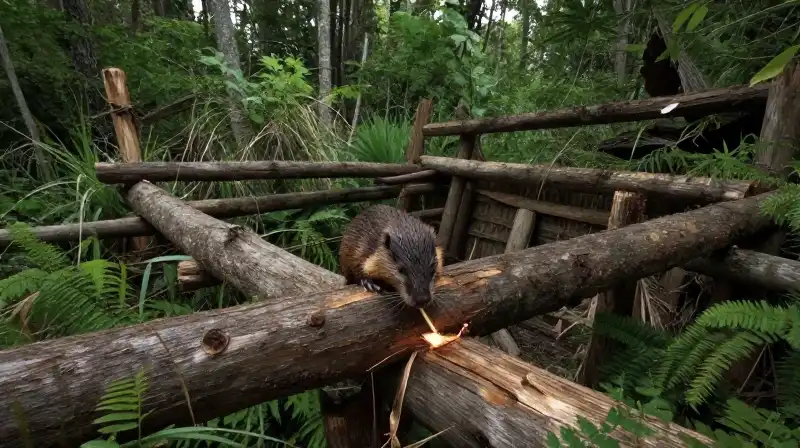
Furthermore, some beavers will notch or cut trees in sections without fully removing them. This focused cutting technique allows them to continuously wear down their incisors without the need to consume the entire tree, reflecting the dual nature of their behavior: a tool for construction and a regulator for dental health.
Ecosystem Engineering: Why They Chew and Build
Beaver activity has a profound impact on the local ecosystem, acting as a form of “ecosystem engineering.” They chew wood and build dams to intentionally alter the flow of water and the landscape.
By constructing large, complex dams from woven sticks, reeds, and branches, beavers create slow-moving ponds and expanded wetlands. These structures serve several critical ecological functions:
- Erosion Control: The dams slow water velocity, which naturally reduces stream erosion downstream.
- Water Purification: The resulting pond environment allows natural filtration processes to occur, purifying the water.
- Habitat Creation: The ponds and structures provide vital shelter, nesting sites, and foraging grounds for numerous aquatic and terrestrial wildlife.
Their modification of the habitat is not merely a way to survive; it is a critical role they play in fostering a diverse and resilient local environment.
Practical Considerations for Beavers and Property
For those who need to understand or manage beaver activity near property, it is useful to know that their need for chewing is often related to their proximity to building materials. While they build for shelter, the instinct to harvest is constant.
The question of how to keep beavers away from trees or mitigate damage depends heavily on the context, as the ideal approach depends on whether the damage is purely aesthetic or poses a genuine structural threat.
| Situation | Beaver Behavior | Recommended Approach |
|---|---|---|
| Dam on stream | Modifying hydrology for habitat/shelter. | Understanding flow redirection and potential flooding; often involves habitat management. |
| Felling live trees | Harvesting raw material for construction. | Installation of exclusion devices or hardware to prevent wood from being accessed. |
| Tree consumption (bark/layers) | Dietary necessity for inner resources. | Selective removal of material or strategic feeding diversion, depending on local regulations. |
Ultimately, beavers are masters of their environment. They are not primarily focused on consuming the entire log; they are focused on processing it—either as a tool for structure or as a source of vital sustenance for their survival.
Synthesis: The True Function of the Beaver’s Bite
To summarize, the beaver’s chewing is a highly sophisticated and specialized behavior. It is the biological mechanism that allows them to maintain their cutting tools and the behavioral method they use to build their homes and alter their environment.
Whether they are cutting a large section of timber to reinforce a lodge or carefully gnawing away bark for a winter snack, the intent is functional. They are not primarily wood-eaters in the way a bear eats berries; they are wood-processors. Their bites are driven by the dual need to sustain their continuous tooth growth and to create the complex, self-sustaining ecosystems that define their presence in the wild.
How to Manage Beaver Activity Near Property
Guide for property owners to address damage or changes in the environment caused by beavers.
Identify the Beaver Behavior
Observe the beaver activity and categorize it (e.g., modifying a dam, felling live trees, or consuming bark/layers).
Assess the Damage Severity
Determine whether the damage is purely aesthetic or poses a genuine structural threat to the property.
Apply Mitigation Strategies
Based on the situation, implement the recommended approach (e.g., installing exclusion devices for felled trees, selective removal for tree consumption, or habitat management for dams).
Related Articles