
How to Score Clay: The Essential Guide to Secure Pottery Bonds

Introduction
Scoring clay is not a decorative step; it is a foundational necessity in ceramic construction. If two pieces of clay are joined without proper preparation, they will separate during the drying process or, more critically, during firing. This technique prepares the surface of two components to create a bond that functions more like welding than simply gluing. The process of scoring—creating cuts or gashes into the clay—drastically increases the surface area, allowing the slip (a clay-water adhesive) to penetrate deeply and create a strong, unified structure. Mastering this technique is the difference between a temporary assemblage and a permanent ceramic piece.
The Mechanics of Bonding: Why Surface Area is Critical
The primary purpose of scoring clay is to transition the joining area from a slick, passive interface to a chemically and mechanically active one. Unlike many external adhesives used for woodworking or plastic, pottery requires the material itself to fuse. A smooth surface offers virtually no grip, providing minimal points of contact. Scoring addresses this deficiency through two main mechanisms:
- Mechanical Interlocking: The cuts or grooves created by scoring function like microscopic teeth. When the two scored pieces are pressed together, the material naturally “interlocks” within these irregular textures, resisting pull and pressure.
- Increased Adhesion: By maximizing the contact interface, you provide more real estate for the slip to reach. This prevents the bond from relying solely on a thin film of liquid (the slip) and encourages deep penetration into the clay body.
In the context of a kiln, this thorough preparation ensures that the unified body can withstand the stress of temperature changes and thermal expansion.
The “Score and Slip” Technique: Step-by-Step Guide
The scoring and slipping process is a deliberate ritual that must be followed to achieve structural integrity.
Choosing Your Tools and Slip
The effectiveness of the bond often depends on the tools and the adhesive used.
- Scoring Tools: While specialized pottery tools exist, effective scoring can be achieved with sharp objects like needles, pins, forks, or combs. For best results, ensure the tool is clean and sharp to avoid tearing the clay rather than just creating a score.
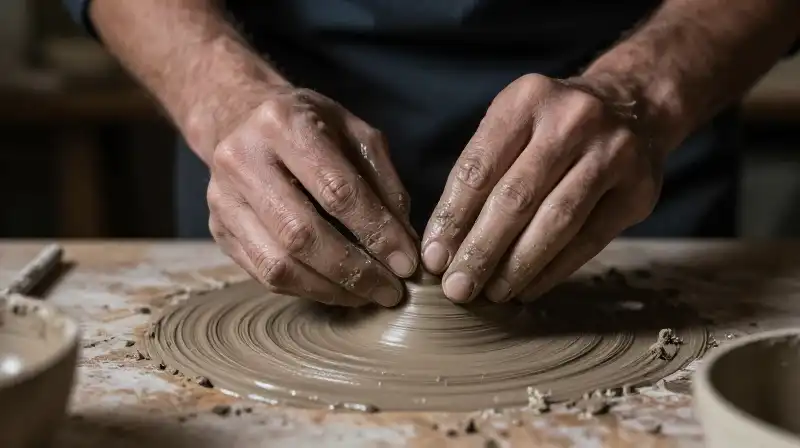
- Scoring Technique: Apply scoring in a “crisscross” pattern across the intended joining area. The score should be deep enough to be visible and robust but should never extend past the designated joint boundary.
- The Slip: Slip is a slurry composed of clay and water. Traditionally, it is this slip that is used as the primary adhesive. However, potters may also use simpler substitutes such as a concentrated water solution, spit, or vinegar mixed with water, provided the components are moist and receptive to the score.
The Joining Process
Once both surfaces have been scored, the slip is applied to the matching areas. The clay must be thoroughly moistened—not saturated, but dampened enough for the slip to adhere.
- Apply a layer of slip to the scored surface of Piece A.
- Apply an equal layer of slip to the corresponding scored surface of Piece B.
- Press the two pieces together firmly, ensuring that the scored areas are fully engaged and the slip is evenly distributed within the grooves.
- Carefully wipe away any excess slip from the exterior surfaces using a damp sponge or brush.
Addressing Common Errors: What Happens If You Don’t Score Clay?
Failure to score clay is a common mistake made by beginners, and the resulting piece will suffer from critical structural weaknesses. When you join clay without scoring, you rely only on a thin film of slip between two parallel, smooth surfaces. The consequences of skipping this step are significant:
- Delamination: The pieces are highly likely to separate or slide apart. The adhesive film provides weak points that cannot resist the stresses of drying (where shrinkage occurs) or the intense heat of the kiln.
- Structural Instability: Without mechanical locking, the joint cannot handle its own weight or the pressure applied during handling, leading to potential breakage.
- Inconsistent Shrinkage: Clay shrinks as it dries. If the join is weak, differential shrinkage between the smooth and scored areas can cause the joint to crack or fail completely.
Post-Join Handling and Drying Requirements
After successfully joining pieces, the job of “scoring” is complete, but the construction is not yet finished. Because the bond relies on moisture distribution, the assembled structure must be handled with care to ensure an even set. The pieces should be kept in a humid environment—perhaps covered with plastic or in a mist-controlled area—to allow the moisture to meld thoroughly between the parts. It is critical that the entire structure remains covered until the pieces are “bone dry.” This means the structure must reach a state of complete dryness, where all water has evaporated, before it is ready for the bisque firing. Drying too quickly or insufficiently is one of the most common causes of failure for joined ceramic pieces.
Synthesis: Evaluating a Permanent Clay Bond
A successful scored clay bond is a blend of mechanical and chemical adherence. You can evaluate the effectiveness of your joint by ensuring these criteria are met:
| Criterion | What to Look For | Why It Matters |
|---|---|---|
| Full Engagement | The scored areas are visibly mated, and the slip is filling the deep grooves. | Ensures the mechanical interlock is established. |
| Even Slip Distribution | The slip coverage is consistent across both joining surfaces. | Prevents weak spots caused by concentration of pressure on only one side. |
| Cure Time | The pieces have been dried completely to bone dryness. | The joint cannot survive the thermal stress of firing if trapped moisture remains. |
Frequently Asked Questions
What happens if you don't slip and score clay?
Without scoring the clay, the joint relies only on a thin film of slip between smooth surfaces, leading to delamination or sliding apart. This lack of mechanical interlocking also causes structural instability and potential failure during drying or firing due to inconsistent shrinkage.
Related Articles