
How Plywood Is Made: The Complete Manufacturing Process

Introduction
Plywood is a composite material engineered for exceptional strength, stability, and durability. It is not simply wood, but a structural material created by bonding multiple thin sheets of wood together. The manufacturing process transforms raw timber—specifically thin shavings known as veneer—into a cohesive, multi-layered board. At its core, the “how plywood is made” involves a complex cycle of fiber preparation, drying, precise stacking, and high-pressure lamination. This systematic approach allows the final product to outperform solid wood or simpler engineered wood like fiberboard.
The Creation of Veneer: From Log to Thin Sheet
The entire lifecycle of plywood begins with the preparation of the raw log. Plywood is not made from waste particles but from intact, thin slices of wood called veneer.
Initial Log Preparation and Peeling
Once the log is harvested, it must be processed extensively. This initial stage involves:
- Bark Removal: The outer layers of the log are stripped away.
- Cutting: The log is cut into manageable blocks.
- Steam Treatment: The blocks are subjected to high-heat steam. This process is critical; the heat breaks down the wood’s internal fiber structure, making it pliable and easier to peel.
- Rapid Peeling: Using specialized lathes, the steamed wood is rapidly peeled into extremely thin sheets. These veneers typically range from 1/200th to 1/10th of an inch thick.
The resulting veneer sheets resemble large, uniform wooden shavings, ready for quality control.
Sorting, Grading, and Cutting
Before lamination can occur, the raw veneer must be optimized. Sheets are moved to rotary clippers where they are digitally scanned for defects such as splits, blemishes, or knots. The wood is also sorted based on its composition (e.g., heartwood vs. sapwood) and its natural characteristics. These sheets are then cut into uniform sizes required for the specific plywood panel they will eventually form.
Drying and Preparation for Lamination
Even after peeling and cutting, the veneer is still highly moist. If this moisture content were not controlled, the final plywood would warp, crack, or suffer from dimensional instability. The sheets are transported through an industrial dryer until the moisture content is reduced to a target of 8 percent or less. This controlled drying phase is perhaps the most vital step in ensuring the structural integrity of the finished product. Simultaneously, the pieces are categorized into precise stacks based on their width, thickness, and grain type.
The Lamination Stage: The Bonding Process
The final stages of production occur in the plywood mill, where the individual sheets are merged into a single, durable composite panel. This stage is defined by two key factors: glue application and grain orientation.
Applying the Adhesive and Strategic Stacking
The dried veneer sheets are coated with a strong laminate glue. These glued layers, known as plies, are then carefully stacked onto a press. The most crucial decision in this entire process is the arrangement of the wood grain. Plywood sheets are not stacked with the grain running in the same direction. Instead, adjacent plies are oriented at perpendicular angles (90 degrees to each other). This alternating grain pattern is what provides plywood with its superior strength and resistance to splitting. If the grain were continuous, the sheet would behave like solid wood, offering strength in one direction but weakness in another. By rotating the grain, the forces that try to pull the wood apart are distributed across multiple directions, preventing the material from splintering under stress.
Pressing and Curing the Panel
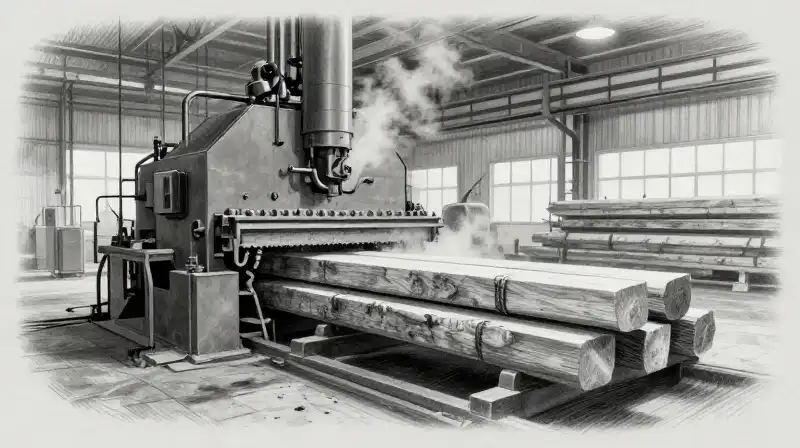
Once the stack of veneered plies is positioned, it is transferred into a powerful hydraulic press. The press applies immense pressure and heat simultaneously. This intense environment performs two functions: 1. It forces the liquid glue into every micro-gap between the wood fibers. 2. It cures the glue, creating a permanent, waterproof bond that turns the stack of individual sheets into a solid, monolithic panel.
Plywood vs. Other Engineered Wood Materials
A common point of confusion is the distinction between plywood and other board types found in the building industry. While they share the use of wood fibers, their construction methods are fundamentally different.
Intact Layers vs. Ground Particles
Plywood’s defining characteristic is that it is made of *entire, intact* sheets of veneer glued together. This structure provides cohesion and strength derived from the whole sheet. In contrast, materials like:
- MDF (Medium-Density Fiberboard): Is created by crushing and grinding wood fibers into a fine powder that is then mixed with resin and pressed. This makes it stable and smooth, but lacks the layered structural strength of plywood.
- OSB (Oriented Strand Board): Is made from individual wood flakes (strands) that are glued together in specific orientations. While strong, it does not possess the coherent, continuous sheet structure of traditional plywood.
Common Variations in Plywood Construction
Though the basic manufacturing principle remains constant, plywood can be optimized for different uses:
- Softwood Plywood: Made from various softer woods like Douglas-fir, which is common for general construction and framing.
- Hardwood Plywood: Uses dense hardwoods like oak or maple, typically chosen for high-end furniture or surfaces that require significant resistance to wear.
- Marine-Grade Plywood: Features specialized resins and heavy-duty sealing processes, making it highly resistant to moisture and decay, suitable for outdoor or wet environments.
Practical Considerations in Plywood Manufacturing
The factory processes involved in how plywood is made also dictate its eventual use. Understanding these quality controls helps consumers assess the final product:
| Manufacturing Step | Practical Importance | What It Addresses |
|---|---|---|
| Steam Treatment & Peeling | Ensures the veneer is uniformly thin and pliable. | Prevents tearing during the subsequent gluing process. |
| Moisture Content Reduction | Limits the rate of dimensional change. | Prevents warping or peeling after installation. |
| Perpendicular Grain Arrangement | Maximizes structural integrity. | Provides strength in multiple axes, reducing material failure. |
| The final dimensions of the sheet are always limited by the size of the original tree from which the veneer was cut, meaning that very large pieces of plywood require very large trees. |
The manufacturing journey from raw log to finished plywood is a testament to the balance between natural materials and industrial engineering. It is not just about glue and sheets; it is a systematic process of preparation, quality control, and strategic structural design.
Frequently Asked Questions
Is plywood 100% wood?
Plywood is a composite material, not simply wood, and is a structural material created by bonding multiple thin sheets of wood together. These layers, known as plies, are coated with and bonded using a strong laminate glue during the production process.
Why are there footballs in plywood?
The provided article does not contain any information about football being in plywood. It focuses exclusively on the manufacturing process, materials, and structural engineering of plywood.
What is the process of making plywood?
The process involves taking raw log and transforming it into thin veneer sheets through steam treatment and rapid peeling, followed by drying and cutting. Finally, these dried plies are coated with glue, strategically stacked with perpendicular grain orientations, and cured into a solid panel using immense hydraulic pressure and heat.
How to Manufacture Plywood
Prepare and Peel the Veneer
Begin by stripping the bark and cutting the raw log into blocks. Subjects these blocks to high-heat steam to break down fiber structures, making them pliable for rapid peeling into thin veneer sheets (typically 1/200th to 1/10th of an inch).
Grade and Cut the Sheets
The raw veneer is moved through rotary clippers where it is digitally scanned for defects. The wood is sorted by composition and natural characteristics before being cut into uniform sizes suitable for the final panel.
Reduce Moisture Content
The cut sheets are transported through an industrial dryer to reduce the moisture content to 8 percent or less, a critical step to prevent warping or cracking during and after installation. The pieces are then categorized into precise stacks based on their dimensions.
Apply Adhesive and Orient Grain
The dried veneer sheets are coated with a strong laminate glue. They are then stacked as "plies," with adjacent sheets oriented at perpendicular angles (90 degrees) to each other, ensuring maximum structural integrity.
Press and Cure the Panel
The stack of veneered plies is placed into a powerful hydraulic press. The application of simultaneous immense pressure and heat forces the glue into every micro-gap, permanently curing the bond to create a single, solid panel.
Related Articles