
Understanding Underwater Welding: Wet vs. Dry Process

Introduction
Underwater welding is a highly specialized discipline that requires merging the techniques of high-end metalworking with the rigorous demands of commercial diving. It is not a single process but a classification of methods used to join materials in submerged environments. To understand how underwater welding works, one must first grasp that the method employed—either wet or dry—is determined entirely by the physical environment required for the specific application. While both techniques aim to bond metal using intense heat, the way they manage oxygen, heat dissipation, and current conductivity differs fundamentally.
The Physics of Submerged Arc Welding
At its core, underwater welding is a variation of standard arc welding, but it operates under conditions that drastically alter the electrical and thermal physics. When welding metals in the atmosphere, the ambient air acts as an insulator. Underwater, the medium is water, a highly conductive fluid. This conductivity is essential for completing the electrical circuit. The greatest challenge in the underwater environment is heat management. Water has an extremely high capacity for absorbing heat. As the electric arc melts and fuses the filler metal, the surrounding water rapidly disperses and vaporizes that intense thermal energy, converting it into steam bubbles. While the water is excellent at conducting heat *away* from the weld joint, maintaining a stable, high-temperature pool of molten metal requires specialized electrical settings and protective measures to ensure the integrity of the finished bond.
Wet Welding: Welding Through the Water
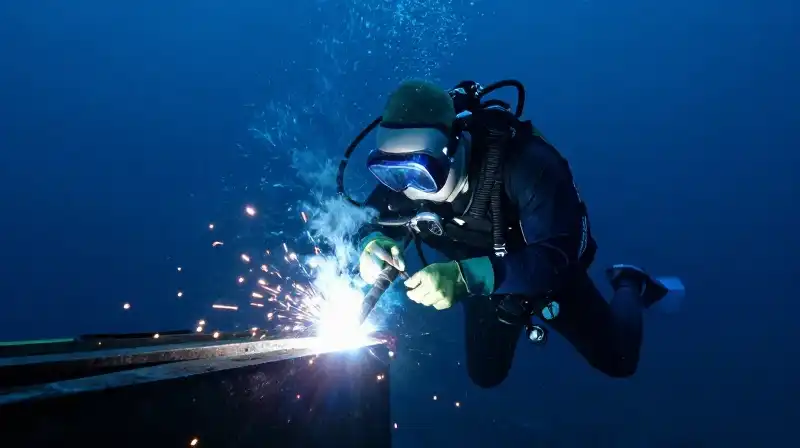
Wet welding refers to the practice of performing the entire welding operation directly within the surrounding water. This technique is common in emergency repairs or when access to a specialized chamber is impossible. It relies on two primary principles: extreme amperage and gas shielding. In wet welding, the electric arc generates superheated gas (often from flux or filler material). This rapidly forming gas bubble is critical; it serves as an insulator, protecting the molten pool from the surrounding oxygen in the water. If oxygen were allowed to reach the weld pool, the heated metal would immediately oxidize, becoming brittle and causing the weld to fail. Techniques like Stick welding and Flux-Cored Arc welding are frequently used in wet environments because the associated consumables and processes are robust enough to function under the rapid heat loss conditions. The consistent use of Direct Current (DC) is often preferred for safety and control, minimizing the risk associated with alternating current (AC) exposure to the diver.
Dry Welding: The Controlled Environment
Dry welding eliminates the need to rely on protective gas bubbles by physically removing the water from the workspace. This process typically involves confining the diver and the weld area within a hyperbaric chamber or a specialized dry habitat. By isolating the welding process in a pressurized, dry atmosphere, the environment essentially reverts to atmospheric welding conditions. This controlled environment allows for the use of highly precise and advanced methods, such as TIG (Tungsten Inert Gas) and MIG (Metal Inert Gas) welding. The hyperbaric chamber maintains a breathable, controlled atmosphere while providing the necessary pressure and containment to prevent moisture interference.
Wet vs. Dry Welding: A Comparison
The choice between wet and dry welding involves balancing equipment complexity, operational time, and required weld quality.
| Feature | Wet Welding | Dry Welding |
|---|---|---|
| Environment | Directly submerged in water | Contained within a hyperbaric chamber |
| Gas Shielding | Utilizes an arc gas bubble (flux) | Utilizes the inert gas in the dry chamber |
| Process Examples | Stick welding, Flux-Cored Arc | TIG welding, MIG welding |
| Complexity | Lower setup, relies on consumables | High equipment cost, complex life support |
| Weld Quality Potential | Good for structural repairs; susceptible to rapid cooling/defect | Highest potential for precision and quality |
Operational Risks and Safety Considerations
Despite its necessity for maritime and industrial infrastructure repair, underwater welding is an extremely hazardous occupation. The proximity to highly conductive saltwater and high-voltage electrical currents presents significant, inherent dangers.
- Electrocution: Because water is an effective conductor, the risk of electric shock or fatality is constant. Rigorous isolation of the welding circuit from the diver is mandatory.
- Pressure Injuries: Operations often take place in high-pressure environments, increasing the risk of decompression sickness (the “bends”).
- Environmental Stress: The rapid cooling of the weld joint underwater can induce significant thermal stresses, potentially leading to structural defects that require careful inspection.
Therefore, successful operation demands a diver who is highly proficient in commercial diving and possesses a professional background in welding, understanding that the risks are magnified by the challenging environment.
Synthesis: When to Choose Which Method
The primary decision point for any industrial project is determining the required precision versus the available infrastructure. If the goal is a rapid, robust structural repair on a vessel or pipeline where perfect aesthetic quality is secondary to immediate reinforcement, wet welding may be the viable choice. Conversely, if the application requires high-integrity welds—such as those found in delicate or critical components like nuclear facilities—the meticulous control afforded by dry welding within a hyperbaric chamber is the superior and necessary methodology. Regardless of the choice, the successful execution relies on a mastery of both specialized electrical application and environmental risk mitigation.
Frequently Asked Questions
Why don't underwater welders live that long?
Underwater welding is an extremely hazardous occupation due to significant inherent dangers, including the constant risk of electrocution from proximity to high-voltage electrical currents and conductive saltwater. Furthermore, operations often take place in high-pressure environments, increasing the risk of decompression sickness.
Related Articles