From Larva to Queen: Understanding the Ant Reproductive Process

Introduction
The transformation of a female ant into a queen is not a single, universal biological process; it is a complex, species-specific cascade governed by nutritional inputs, genetic regulation, and social dynamics. A queen, or gyne, is the primary reproductive female of an ant colony, responsible for laying eggs and directing the colony’s expansion. Understanding how an ant becomes a queen requires looking at several distinct pathways: the chemical and nutritional programming during larval development, the ritual of nuptial flight, and the various social mechanisms that determine reproductive status within a colony.
The process is fundamentally about caste determination. Whether a worker develops into a reproductive queen, a sterile worker, or a soldier depends heavily on environmental signals received during its juvenile stage.
The Nutritional Blueprint: Larval Development and Caste Selection
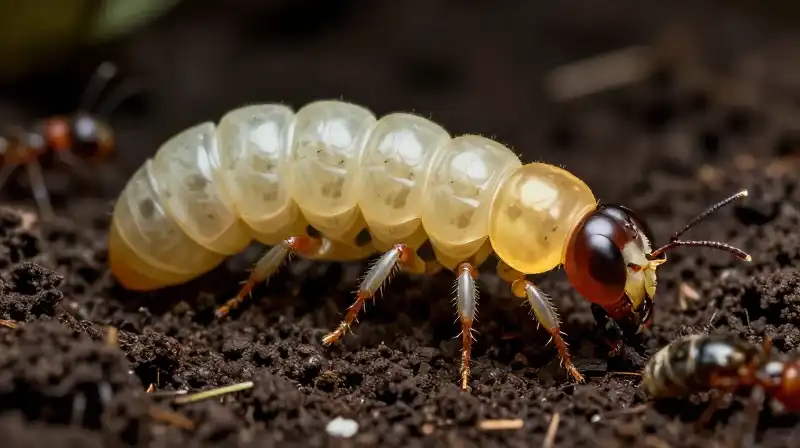
The initial determination of a female’s fate—whether she becomes a queen, a worker, or a sterile caste member—is heavily dependent on the quality and composition of her larval diet. This concept is known as nutritional programming, which influences the size and physical characteristics of the developing ant.
Larvae that are consistently provided with highly nutritious food, often supplemented with specialized substances like specific honeys or jellies, are physically encouraged to grow larger. In many species, greater size is a visual and physiological indicator that a female possesses the potential to develop into a queen. These larger females are then designated for queen development.
The Role of Epigenetic Switches
Beyond mere feeding, the physical development of an ant is regulated by sophisticated internal switches known as epigenetic mechanisms. These epigenetic factors control how genes are expressed without changing the underlying DNA. In ant species, these switches are what dictate the final caste: the gene for a queen is activated, while the gene for a worker remains active, even though both potential castes originate from the same basic genetic blueprint.
When resources within the colony are abundant and conditions are ideal, these epigenetic switches favor the development of a sexually mature queen. Conversely, resource scarcity can shift the developmental path toward producing more sterile workers to ensure colony survival.
Social Dynamics and the Path to Queenhood
In addition to purely physiological triggers, social interaction and colony competition play a significant role in determining who assumes the reproductive role.
Promotion and Selection
In some ant species, the process of becoming a queen is not restricted solely to the initial brood but can involve promotion. An existing, sterile female member of the colony may be chosen or promoted into the role of queen. This promotion can be determined through social signals or even physical conflict.
Competition, sometimes manifesting as direct aggressive interactions between females, can serve as a mechanism for selection. The dominant or more forceful individual may successfully challenge others to assume the reproductive role, establishing itself as the new queen.
The Cycle of Reproduction: Nuptial Flights and Colony Founding
For many sexually reproducing ant species, the ultimate “queen” is not born directly in the established nest; she emerges from a specialized developmental stage and undertakes a critical reproductive journey.
From Larva to “Princess Ant”
When environmental cues indicate optimal mating conditions, certain larvae are selected to develop into winged, sexually mature females, often referred to as “princess ants.” These are the potential queens of the next generation. The initial development of these winged females is heavily dependent on the high level of nourishment they receive.
When the colony reaches the appropriate density and timing, large masses of these winged ants engage in a nuptial flight. This mass migration serves the sole purpose of mating. During this flight, the female ant flies to mate with at least one male from a different ant colony. These males are often haploid (containing one set of chromosomes), while the females are diploid (containing two sets), leading to the fertilized queen.
Foundations and Wing Shedding
Following successful mating, the newly emerged queen selects an appropriate area to establish a new colony. Once she finds a safe and suitable territory, she begins the founding process. A key transition occurs at this point: the queen sheds her wings. The now wingless, mature queen is the only member of the nascent colony capable of laying viable eggs.
Exceptions to the Rule: Asexual Reproduction and Queen Removal
The lifecycle of the ant queen is highly varied, and not all processes fit the standard model of nuptial flight and fertilization.
Asexual Reproduction (Cloning)
Some ant species utilize asexual reproduction, or cloning. In these instances, females are capable of reproducing without needing to find and mate with a male. They can lay unfertilized eggs, which themselves develop into fertile clones. This eliminates the need for a nuptial flight and simplifies the path to queen status, though it doesn’t eliminate the need for strong social regulation to maintain colony hierarchy.
Multiple Queens and Colony Decline
While many ant colonies rely on a single queen, certain species are polygyne, meaning they maintain multiple reproducing queens. Furthermore, in some cases, a queen may be actively removed by the colony. This often occurs when the established queen declines in fertility or if external factors suggest a new reproductive cycle is needed. In extreme scenarios, this removal can involve the colony killing the queen, a mechanism to enforce reproductive change and maintain colony vigor.
Summary of Ant Queen Determination
The ant queen is a sophisticated outcome of biological forces. Whether a female is designated a queen—and how—is determined by a complex interplay of the following factors:
- Diet: High-quality larval nutrition acts as a primary signal to trigger queen development.
- Genetics: Epigenetic switches regulate the final caste expression.
- Social Signals: Competition and promotion allow existing females to assume reproductive roles.
- Reproductive Timing: In sexually reproducing species, the queen is typically formed and emerges during the nuptial flight following successful mating.
- Species Specificity: The reproductive mechanisms range from obligate sexual reproduction to asexual cloning, depending entirely on the ant species.
The queen’s primary function remains the sole production of the next generation of workers and future reproductives, a role she can maintain for many years depending on the species.
How Ant Queens are Formed and Establish a Colony
Larval Selection and Development
Certain larvae are selected and heavily nourished to develop into winged, sexually mature females, often referred to as "princess ants" or potential queens.
Nuptial Flight and Mating
Masses of winged ants migrate during a nuptial flight to mate with males from a different ant colony, resulting in the fertilized queen.
Territory Selection
The newly mated queen finds a safe and suitable territory to establish a new colony.
Wing Shedding and Founding
The queen sheds her wings, becoming wingless and mature, and begins laying viable eggs to initiate the colony's founding process.
Related Articles