
Dart Scoring Explained: Bullseye Points and Board Values


Introduction
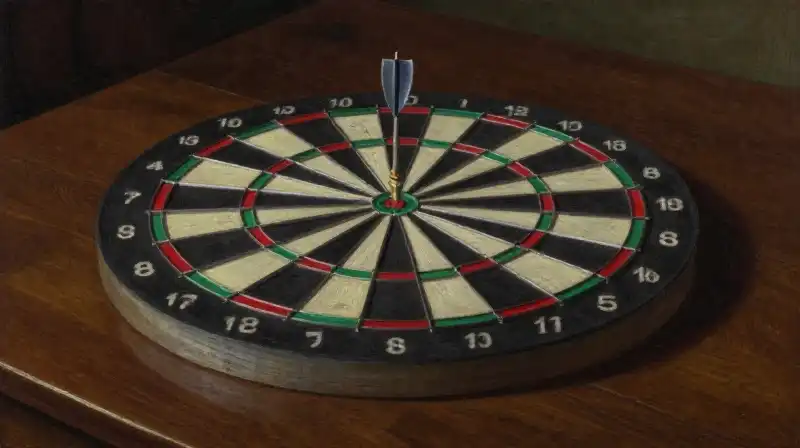
The most direct answer to “What is the score of the bullseye on a dartboard?” is that the bullseye is not a single value; it is divided into two distinct segments, each with a unique score. The outer ring of the bullseye scores 25 points, while the smaller, central double bullseye scores 50 points. While hitting the highest possible value (180 points) is a high-risk feat, the bullseye scores are critical to understanding how every single throw contributes to the total, whether you are aiming to achieve the maximum score or simply progressing strategically toward a required target number.
Understanding the Dartboard Scoring Zones
Scoring in darts is defined by the physical segment a dart lands in, which determines whether the point value of the surrounding number is taken once, twice, or three times. This segmentation is fundamental to any darts scoring calculator or chart.
To accurately track your score, you must recognize three primary scoring zones:
- Single Ring: Scoring the number itself (e.g., landing in the single 20 ring yields 20 points).
- Double Ring: Doubling the score of the number above it (e.g., landing in the double 20 ring yields 40 points).
- Triple Ring: Tripling the score of the number above it (e.g., landing in the triple 20 ring yields 60 points).
The Breakdown of the Bullseye Score Darts
The bullseye section is distinct from the surrounding numbered segments because it uses a fixed point system rather than a numerical multiplier.
There are two critical bullseye point values:
- Outer Bull (Single Bull): This segment scores a flat 25 points.
- Inner Bull (Double Bull): This central segment scores a flat 50 points, representing the highest achievable value on a single dart throw.
The Tactical Importance of Scoring Segments
In competitive darts, the goal is rarely just to hit the bullseye. The game is a mathematical challenge centered around reaching a specific total (most commonly 501). Therefore, strategic scoring—choosing between high-risk, high-reward areas and safer, consistent points—is often more important than pure accuracy.
The layout of the dartboard facilitates different tactical choices based on the remaining score in the game:
- Maximum Attack (High Risk): When the score is high, players often target Triple 20, as three hits can yield 180 points, significantly reducing the work left. The risk is high; a miss results in a loss of scoring opportunity.
- Strategic Reduction (Mid-Game): As the score drops, players often use the single ring and less aggressive doubles to control the pace and ensure they hit the necessary number without overshooting.
- The Finish (The Double Out): The final phase of the game requires hitting a double (or the Double Bull). This dictates that the player must use the doubles to bring the score exactly to zero, as hitting a single or a triple would leave an incorrect remainder.
Differentiating Scoring Strategies and Limits
Not all scoring attempts are equal, and understanding the limits of the board helps players avoid costly errors.
The maximum score achievable in one turn (three darts) is 180, achieved by hitting Triple 20 three times. Conversely, hitting the Outer Bullseye 25 points or the Inner Bullseye 50 points dramatically changes the mathematical approach needed to finish the game.
It is a frequent error for novice players to view the bullseye as simply the “best” target. While 50 points is higher than any single 20 segment, it is actually a significant risk, as a slightly off-center throw often misses the bull entirely, resulting in a much lower score. Advanced dart players use the bullseye as a tactical tool—a massive point injection when the remaining score is high, or as the guaranteed finisher when the score is at 50.
Summary of Dart Scoring Principles
To summarize the essential rules for dart scoring:
| Segment Type | Value Calculation | Typical Use |
|---|---|---|
| Single Ring | Base value (e.g., 20) | General point accumulation |
| Double Ring | Base value x 2 (e.g., 40) | Used to “double up” or, crucially, to finish a game. |
| Triple Ring | Base value x 3 (e.g., 60) | Rapid point accumulation (maximum scoring). |
| Outer Bullseye | Fixed 25 points | Strategic score injection. |
| Inner Bullseye | Fixed 50 points | Maximum single-throw score and guaranteed finisher. |
Ultimately, successful darts requires blending raw accuracy with strategic calculation. Knowing the exact dartboard bullseye score allows you to adjust your mathematical path, ensuring that whether you are aiming for 501 or simply seeking the highest points, every throw contributes purposefully to the final result.
Frequently Asked Questions
What is the score of the bullseye on a dartboard?
The bullseye is divided into two segments: the outer ring scores a flat 25 points, while the smaller central double bullseye scores a flat 50 points.
Related Articles