
Eurofighter Typhoon vs F-22: Dogfight Tactics and Performance

Introduction
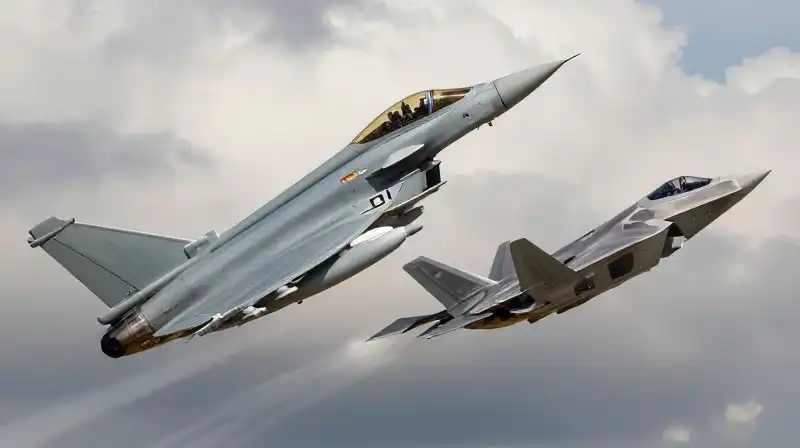
The comparison between the Eurofighter Typhoon and the F-22 Raptor is not a search for a single “superior” fighter; it is a study in two fundamentally different military design philosophies. The core difference lies in their primary operational envelope: the F-22 is optimized for stealth-based dominance in Beyond Visual Range (BVR) engagements, while the Typhoon excels in dynamic, high-energy close-quarters combat (CQC). Determining tactical effectiveness requires understanding where each aircraft’s unique design advantages come into play, as a dogfight outcome is entirely dependent on the range and the operational environment.
Designing for Dominance vs. Designing for Agility
To understand the contrast, one must look at the respective design generations and priorities. The F-22 Raptor is a definitive fifth-generation fighter. Its architecture centers on advanced stealth, sensor fusion, and sophisticated avionics. The goal is to achieve “operational awareness”—allowing the pilot to gather comprehensive data and dictate the engagement before the enemy even detects the presence of the aircraft. This emphasis on signature reduction makes the F-22 the apex predator in long-range, low-observable engagements. In contrast, the Eurofighter Typhoon, an advanced fourth-generation fighter, prioritizes performance and high maneuverability. While incredibly capable in modern multirole roles, its design focuses on achieving exceptional performance in dynamic environments. The Typhoon utilizes its delta-wing configuration and high thrust-to-weight ratio to maintain superior energy and agility during close-range encounters, making it a formidable competitor when BVR engagements fail.
Beyond Visual Range (BVR) vs. Close-In Combat
The performance gap between the two aircraft narrows significantly when the fight moves from strategic to tactical.
F-22: The BVR Specialist
The F-22 excels by remaining unseen. Its low radar cross-section allows it to approach targets undetected, employing advanced avionics to track and engage them with long-range missiles. Stealth is the F-22’s primary tactical tool, granting it the advantage of surprise and distance. In a typical engagement, the F-22’s ability to maintain this tactical gap is paramount to mission success.
Typhoon: The CQC Disruptor
The Typhoon counters the F-22’s BVR advantage by forcing the engagement closer. If the fight enters the visual range, the Typhoon’s high degree of agility and sophisticated control systems become dominant. Its ability to execute high-G, high-energy maneuvers allows it to manage energy retention and escape complex turning patterns that may challenge the F-22’s ability to maintain a perfect missile solution in extreme close proximity.
Technical Duel: Maneuverability and System Integration
The technical specifications reveal why the close-quarters matchup is so compelling. Both platforms incorporate Thrust Vector Control (TVC), but how they use it reflects their mission sets.
| Feature | Eurofighter Typhoon | F-22 Raptor |
|---|---|---|
| Primary Design Focus | High-energy maneuverability and dynamic combat | Stealth, sensor fusion, and BVR dominance |
| Operational Envelope | Superior performance in close-range dogfighting | Unparalleled situational awareness and stealth survival |
| Agility Advantage | High thrust-to-weight ratio and advanced delta-wing design facilitate exceptional close-quarters agility. | Leverages integrated flight systems and sensor data to optimize high-speed performance and survivability. |
| System Integration | Sophisticated combat capability focused on dynamic, real-time combat requirements. | Extremely high level of integrated avionics, minimizing pilot workload and maximizing strategic employment. |
Defining Tactical Effectiveness in Simulated Dogfights
When modeling a head-to-head dogfight, as often seen in digital combat simulations, the F-22’s initial dominance fades the closer the engagement gets. The Typhoon’s capabilities allow it to leverage its performance profile to mitigate the F-22’s greatest strengths.
The F-22’s stealth grants it initial dominance, but this advantage is fundamentally conditional. Once the engagement transitions from the strategic (BVR) phase to the tactical (CQC) phase, the Typhoon’s high-agility profile allows it to exploit the physical limitations of maintaining perfect missile parameters while in extreme close quarters. The Typhoon’s ability to rapidly change vector and manage high-energy maneuvers challenges the F-22’s flight characteristics in these low-observable environments, making it a highly viable close-range contender.
Decision Criteria: When Each Fighter Excels
The optimal choice between these two platforms is never based on raw power but on the specific mission requirements and operational context. Consider these factors when analyzing their effectiveness:
- BVR Requirements: If the mission requires engaging multiple targets from extreme distances or demanding high levels of tactical surprise (e.g., deep penetration missions), the F-22’s stealth-based sensor fusion is the defining advantage.
- Terrain and Close Proximity: In environments where long-range engagements are impossible, or where the threat is highly dynamic and close, the Typhoon’s superior CQC performance and agility provide a decisive operational edge.
- Mission Longevity and Maintenance: While the F-22 represents the cutting edge of technology, its complex, highly integrated systems can lead to specific maintenance demands. The Typhoon’s modular design often offers different operational simplicity and ease of upkeep, which is a critical real-world consideration.
Understanding the Limits of Technological Dominance
While the F-22 holds the overall technological edge in survivability and BVR dominance, it is crucial to recognize the limits of stealth and sensor superiority. Stealth is not a passive defense; it must be paired with the tactical ability to find and destroy targets. If a combat scenario forces the engagement into a tight, highly maneuverable close-range environment, the F-22’s tactical reliance on BVR missile solutions is directly challenged by the Typhoon’s raw, high-energy physical performance. In summary, the comparison between the Eurofighter Typhoon and the F-22 is a study of conflicting tactical priorities. The F-22 is engineered to win the war from miles away; the Typhoon is engineered to win the fight in the clinch. Real-world combat dictates that mission profiles—not just raw technical specifications—determine which aircraft performs the better.
Related Articles