Why Do Certain Ants Have Wings? Understanding Colony Expansion

Introduction
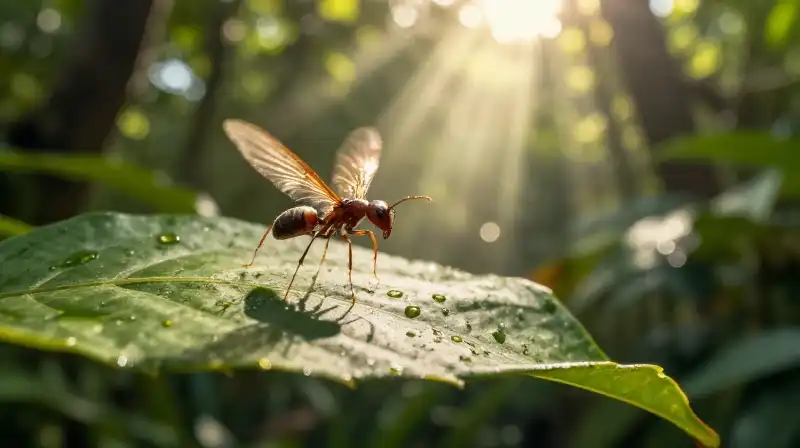
The presence of wings on specific ant individuals is not a coincidence, but a biological necessity tied to the complex lifecycle and expansion of the ant colony. These winged ants, known scientifically as alates, are not your typical foraging or cleaning worker. Their existence is fundamentally about reproduction. The colony you see daily—the massive, highly organized hum of workers—is comprised of sterile females and wingless males dedicated entirely to sustenance. The winged ants, however, are the reproductive agents: potential queens and winged males (drones) whose sole mission is to find mates and establish independent, new colonies elsewhere. Their wings are the tools required for this large-scale biological migration.
The Specialized Roles of Winged Alates
To understand why they have wings, it is crucial to differentiate between the roles within the ant society. The vast majority of workers, often overlooked, are wingless because their duties—foraging, cleaning, and raising brood—are performed entirely within the subterranean environment. Flying ants are fundamentally different. The alates, by definition, are sexually mature and capable of flight.
- Virgin Queens (Princesses): These are the principal winged females. Their purpose is to mate and then locate a suitable, undisturbed site to begin the process of founding a new nest.
- Winged Males (Drones): These individuals are also reproductive, but their role is limited exclusively to mating. Once they have successfully fertilized a queen, they are no longer needed and typically perish shortly after the nuptial flight.
The structure of their body, including specific features like a constricted thorax and elbowed antennae, physically distinguishes them from the smaller, uniform workers, signaling their specialized, reproductive status.
The Purpose of the Nuptial Flight
The primary function of the wing is to facilitate the nuptial flight—a mass migratory event. Ant colonies are naturally inclined to maintain territory and maximize resource availability, but if new queens remained near the old colony, there would be intense competition for space and resources. The flight solves this critical problem. This migratory behavior ensures genetic diversity. By flying long distances, winged queens can mate with males from entirely different colonies. This minimizes inbreeding within a local population and increases the genetic robustness of the future colony. The mass release of these winged ants creates a swarm, which provides a collective advantage, overwhelming local predators and increasing the chances that founding individuals successfully reach new ground.
The Swarming Lifecycle: From Flight to Foundation
The appearance of winged ants is a timed, annual event known as the “flying ant season.” This process is not a random occurrence but a precisely orchestrated biological sequence governed by environmental cues.
The entire process follows a strict timeline:
- Environmental Triggers: The emergence of winged ants is most frequent in hot weather during the summer mating season. Optimal flight requires warm, stable, and non-windy conditions. Some swarming events are even facilitated by moisture, such as heavy rainfall, which can trigger the emergence.
- The Nuptial Flight: The queen and drones take off together. This is a critical window for finding mates from distant colonies.
- Post-Mating Descent: Once the fertilized queen mates, the critical next step is survival. To aid in finding a permanent habitat, the queen must shed her wings.
- Colony Founding: After shedding the wings, the queen becomes a ground-level seeker. She searches for a safe, suitable, and isolated spot where she can begin building her first new nest, thereby ensuring the continuation of the species.
Why Ants Suddenly Appear Outdoors or Indoors
If you notice flying ants in an outdoor area or even inside your home, their presence relates directly to environmental conditions and their search for establishment.
When outside, they are typically responding to ideal conditions: ample sunlight, high levels of food, and moisture. When they enter buildings, they are usually not looking for food to eat but are drawn to environments that offer resources essential for their new life. You might find them around:
- Damp wood or decaying organic matter (a potential site for a new nest).
- Sources of sugary spills or strong scents, which act as general attractants for new colony founders searching for a foothold.
This sudden appearance is simply the result of the seasonal flight coinciding with favorable weather and food availability, which gives the new colony the best chance of survival.
Answering Key Questions: Flight and Safety
Many questions arise regarding these flying individuals. Addressing these directly clarifies their behavior and purpose:
Do ants with wings bite?
The winged queens and males are generally not aggressive. Their focus is entirely reproductive and migratory. Bites usually only occur when they feel severely threatened or are trapped by a human, but this is not a defining characteristic of their function.
Do all male ants have wings?
While only the reproductive males (drones) are winged, it is worth noting that worker ants, which are mostly female, are typically wingless. In some ant species, both males and queens will possess wings during their nuptial phase.
Do female ants have wings?
Yes, certain female ants—the virgin queens—possess wings. Most established worker females do not have wings, as their tasks are confined to the colony.
Practical Caution: Recognizing a Swarm
If you encounter a massive swarm of flying ants, understand that you are witnessing a crucial moment in the expansion of an ant species. While they are a common sight in summer, there is no need for panic. These ants are highly mobile and generally seek a clean, undisturbed area to begin their new, fertile existence. The presence of these individuals is a sign of a healthy, evolving colony. They are merely fulfilling their evolutionary purpose, seeking optimal conditions to establish the next generation of fertile, independent nests. They are pioneers of the ant world.
Ant Colony Swarming and Foundation Process
Environmental Triggers
The emergence of winged ants is frequent in hot weather during summer mating season, requiring warm, stable, and non-windy conditions, sometimes facilitated by heavy rainfall.
The Nuptial Flight
The queen and drones take off together in a mass migratory event to find mates from distant colonies.
Post-Mating Descent
Once the fertilized queen has successfully mated, she sheds her wings as a critical next step to aid in locating a permanent habitat.
Colony Founding
After shedding her wings, the queen searches for a safe, suitable, and isolated spot where she can begin building her first new nest.
Related Articles