The First Taxidermy Walrus: Why Early Preservation Was Flawed

Introduction
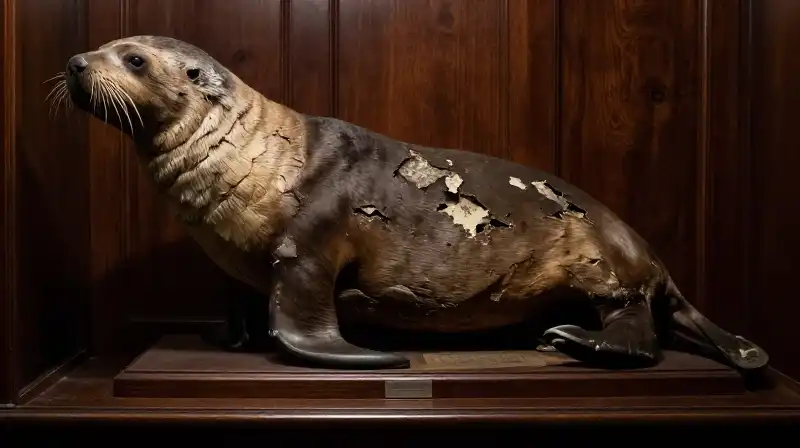
The first taxidermy walrus is not merely a museum artifact; it is a vivid historical case study in early scientific preservation. Housed prominently at the Horniman Museum in London, this specimen presents an appearance remarkably different from a living walrus—it is notably smoother and more rotund than its natural form should be. This atypical silhouette is the result of the taxidermist’s early 19th-century lack of comprehensive knowledge regarding the walrus’s complex biology. Rather than accurately replicating the animal’s distinctive natural skin folds and creases, the original Victorian technique employed excessive stuffing, resulting in an overstuffed form that serves as a permanent reminder of the challenges faced by early natural history curators.
Anatomy vs. Art: The Flaw in Early Preservation
The stark difference between the preserved walrus and a living specimen highlights a fundamental limitation in early taxidermy: the reliance on generalization rather than precise anatomical understanding. Biologically, walruses are characterized by significant, natural skin folds, especially around the neck, joints, and head. These creases are integral to the animal’s natural morphology. The taxidermist who created this specific walrus specimen lacked sufficient prior exposure to live walruses. Consequently, their approach was geared toward creating a smoothed, generalized silhouette. This was achieved through a technique known as “overstuff,” where the specimen was heavily manipulated and filled to effectively eliminate or hide the natural folds they perceived as imperfections.
Why Does the First Taxidermy Walrus Look So Different?
The key to understanding this specimen lies in the intersection of early preservation methods and limited expertise. The resulting form is a direct consequence of the prevailing artistic and curatorial techniques of the era:
- Technique Misapplication: Overstuff methods were used in an attempt to create a more uniform, less rugged appearance.
- Lack of Comparative Knowledge: The taxidermist had not witnessed the natural anatomy, leading to an attempt to “correct” perceived irregularities.
- Historical Context: The Victorian era’s focus on collecting often prioritized the dramatic, impressive silhouette over meticulous biological accuracy in early museum pieces.
Historical Context: From the Hudson Bay to the Horniman Museum
The walrus’s journey provides a clear timeline of its historical significance and movement. The specimen originated from a hunt conducted in the Hudson Bay of Canada. It was first brought to England in 1886, introduced during the Colonial and Indian Exhibition. This period saw a massive influx of natural history specimens, contributing to the burgeoning museum collections. The piece eventually found a long-standing home at the Horniman Museum in London, where it has served as a major institutional centerpiece since the 1980s. While historically kept in custom glass cases, its current prominent display—often situated on a simulated iceberg—solidifies its status as a recognized mascot for the museum’s natural history holdings. Frederick Horniman, the avid collector, is the central figure associated with acquiring and establishing the collection that includes this notable artifact.
The Lesson of the Artifact: How to Evaluate Old Taxidermy
The flaws evident in the first taxidermy walrus offer valuable criteria for understanding the limitations of early preservation. If you are examining historical animal specimens, particularly older taxidermy pieces, it is crucial to recognize that they often reflect the knowledge and methods of their creators, rather than absolute biological truth. To differentiate between contemporary accuracy and historical inaccuracies, consider these practical evaluation signals:
| Feature to Examine | What It Suggest Should Be (Biological Reality) | What Early Flaws Often Suggest (Historical Specimen) |
|---|---|---|
| Skin Texture | Natural creases, folds, and varied skin thickness | Excessive smoothing, uniform, or artificial definition |
| Volume/Shape | Reflecting the animal’s actual musculature and body shape | Overstuff leading to a disproportionately rotund or bloated appearance |
| Overall Style | Detailed, nuanced representation of the living animal | Generalized, dramatic silhouette prioritized over anatomical precision |
Synthesizing the Preservation Challenge
The taxidermy walrus is a tangible example of how anatomical ignorance impacts the long-term record of biodiversity. Its overstuffed appearance is not a desirable aesthetic choice, but a consequence of a taxidermist attempting to impose a standardized form on a creature with complex, unique morphology. Ultimately, this artifact serves a dual purpose: as a valuable historical object and as a crucial reminder of the evolution of scientific observation and preservation. For collectors and enthusiasts, the walrus stands as a powerful indicator of when and how the natural history of a species was recorded, often revealing more about the methods of the past than the perfection of the subject itself.
Frequently Asked Questions
What is the history of walrus taxidermy?
The specimen originated from a hunt in the Hudson Bay of Canada and was brought to England in 1886 for the Colonial and Indian Exhibition. It eventually became a major institutional centerpiece at the Horniman Museum in London, where it has been displayed prominently since the 1980s.
What is the oldest taxidermy walrus?
The first taxidermy walrus, which is the oldest, is currently housed at the Horniman Museum in London. It originated from a hunt in the Hudson Bay of Canada and was first brought to England in 1886 by collector Frederick Horniman.
What is the oldest piece of taxidermy?
The artifact is referred to as The first taxidermy walrus and is housed at the Horniman Museum in London.
How to Evaluate Historical Taxidermy Specimens
Examine Skin Texture
Look for natural creases, folds, and varied skin thickness, or look for excessive smoothing, uniform, or artificial definition that suggests an older specimen.
Assess Volume and Shape
Check if the shape reflects the animal's actual musculature and body shape, or if there is evidence of overstuff leading to a disproportionately rotund or bloated appearance.
Evaluate Overall Style
Determine if the representation is detailed and nuanced, or if it is generalized with a dramatic silhouette prioritized over anatomical precision.
Related Articles